


Campground: Enota Mountain Retreat
RV Camping: Site #6
Enota Mountain Retreat is a non-profit conservation facility outside of Helen, Georgia offering multiple cabins, RV sites for all size RV/campers, and tent camping sites. The facility has a lodge store, large bath house, trout fishing, 2 large waterfalls, organic garden, farm animals, a playground with in-ground trampolines, and a large conference facility. For RVs, the sites offer full hook-up (water, electric, & sewer). All of the tent/RV sites have picnic tables and fire rings. Many of the sites are located directly on one of the streams. This beautiful 60 acre property is settled in a valley minutes away from Brasstown Bald, Georgia’s highest peak. There are multiple hiking opportunities on the property, and countless more only a short drive away. In fact, there is a 2.3 mile spur trail (Jacks Creek Trail) that connects the property to the famous Appalachian Trail at Red Clay Gap. Nearby towns include Helen & Hiawassee, Georgia.
The HIKE: JACKS CREEK to AT (In & Out)
Backpacking Training Hike – Oct. 23, 2019
Total Distance: 7.2 miles
Hiking is one of my favorite activities when camping, and I usually do several hikes on a trip. This trip I wanted to have a little extra time to relax, but still hoped to get in one hike to be able to test out my new backpacking equipment and train while wearing my pack. The plan was to start at Enota Mountain Retreat, take the Jack’s Creek trail on the Enota property to intercept the Appalachian Trail. Then follow the Appalachian Trail to the Blue Mountain Shelter, stop for lunch, and backtrack to return to the RV.
CLICK HERE to skip ahead to a more detailed description of the HIKE.
Day by Day Itinerary
Oct. 22 – 25, 2019
Day 1: Arrival / Setup Camp & Packs / Dinner

I arrived at Enota Mountain Retreat around 5:30pm on Tuesday, October 22, 2019. The lodge was closed, but Enota provides site information ahead of time so I went to my assigned site (RV Site #6) and setup the RV. If you arrive after hours, you simply have to grab your packet from the lodge door bulletin board and check in with the lodge the following morning.
In my opinion, setting up the RV (Thor ACE) is much quicker than the setup process of a travel trailer thanks to a self leveling system and not having to unhook from a truck. My outside setup consists of hooking up hoses & cords, and putting out camping chairs, lights, a rug, and a grill. Inside I unpack clothes, unpack food, put sheets on the bed, and pull out soap or anything else that has been put away during transit. All in all, setup takes around an hour – and less if I have help from friends.

Since I arrived a little later than I had originally planned, I decided to make an easy “inside the camper” dinner instead of one of the campfire/grill meals I had brought. I had spinach & ricotta ravioli with pesto sauce, and garlic bread.
A main goal for this trip was to do a mock backpacking hike to test out my new backpacking gear. I wanted to fill my pack as though I would be staying at a backcountry campsite overnight, then do the hike carrying the pack. I also wanted to do a mock setup and teardown of the backpacking tent. I spent most of the evening going through my backpacking supplies, taking an inventory of what I thought I was missing or wouldn’t actually need, and loading up the pack for the next day. I also planned out the route I wanted to take on the hike.
After that, I stayed inside the nice warm camper watching movies & drinking wine before calling it a night.
Day 2: Backpack Test Hike / Mock Tent Assembly
My original plan for the day was to get up at 7am or 8am, and hit the trail early. I wanted to make it from Enota to Blue Mountain Shelter on the Appalachian Trail and back with time to setup and tear down the tent before dinner at the RV. I was exhausted and decided to sleep in until closer to 10am. No regrets.
Since I wanted to get out onto the trail as quickly as possible, I opted for coffee and a quick breakfast of Kodiak Cakes Cups. They are surprisingly good! All you have to do is add water and microwave. So far I have tried the blueberry muffin cup and the chocolate peanut butter flapjack cup. The muffin cups and the flapjack cups are a different consistency, in line with what you would expect from an actual muffin versus a flapjack. The flapjack one would be better with syrup, so consider that when you are packing up!

After a quick breakfast, it was time to add water and food to my backpack and head out onto the trail. My new backpack is an Osprey Exos 38 pack. I like the smaller pack as it fits better on my 4’11” frame. A lot of people prefer the Osprey Exos 58. But that is exactly why they make multiple sizes! I started the hike around 11am and was back by 4pm. I was able to easily make the goal point of Blue Mountain Shelter despite the later start. (A more detailed description of the hike is below.)
The Hike: JACKS CREEK – AT (Out & Back)
Backpacking Training Hike – Oct. 23, 2019
Total Time: 4 hours & 2 min
Total Distance: 7.2 miles

PHASE 1: I began my hike at 11:50am from RV Site #6 at Enota Mountain Retreat. I walked by the steps to the beginning of Jacks Creek Trail and made my own path up the side of the mountain next to the lodge and intercepted Jacks Creek Trail a little further down. In hindsight, this neither saved me time nor effort, it was simply what I had done the last time I hiked up to the Appalachian Trail from Enota.
Jacks Creek Trail is a spur trail that leads from the campground to the Appalachian Trail, closely following Jacks Creek, hence the name of the trail. The outbound trail to the AT is entirely uphill, and the last part is quite steep. The trail is approximately 2.2 miles in length (one way) and is marked with blue blazes. I reached the junction with the Appalachian Trail at Red Clay Gap at 12:52pm (so about 1 hour from when I started).

PHASE 2: I paused for a moment to catch my breath, and left Red Clay Gap at 11:58pm. I headed eastbound, following the white blazes of the Appalachian Trail, with the goal of making it to Blue Mountain Shelter or hiking for about 2 hours, whichever came first. At 1 hour 27 minutes/ 2.87 miles (1:18pm) I made it to a small sign indicating a campsite/water source. I took a moment to investigate the campsite and left the sign at 1:24pm. The trail then became fairly rocky as I continued towards the shelter. I encountered another sign for a water source at 1 hour 34 min/ 3.17 miles (1:30pm). I encountered one more sign for water at 1 hour 56 min/ 3.8 miles (1:51pm). I was able to make it to Blue Mountain Shelter at 2 hours/ 3.97 miles (1:57pm). At Blue Mountain Shelter, I stopped to enjoy a lunch that included bananas, almonds/peanuts, and tuna packets. The entire outbound portion of the AT from Red Clay Gap to Blue Mountain Shelter was slightly uphill, but not steep.


PHASE 3: My lunch at Blue Mountain Shelter was approximately 30 minutes. Then I started to hike back, retracing my steps the way I came, at 2:23pm. Since the outbound hike was almost entirely uphill, I figured the return hike would be mostly downhill, and therefore result in a faster time. I made it back to the sign indicating a campsite/water at 2:50pm (27 minutes on the way out versus 33 minutes on the way in – so not much difference after all). I made it back to Red Clay Gap with a total hike time of 2 hours 46 min/ 5.6 miles (3:09pm).
At that point all I had left was the return along Jacks Creek Trail to Enota. I completed the total out & back hike in 4 hours 3 minutes (3:53pm).

PHASE 4: After returning to the RV, I wanted to do a trial run of setting up and repacking my backpacking tent to get an idea of how long each part of the process would take on the trail. I thought this information would be useful when doing backcountry hikes of multiple days and planning when/where to shoot for as a stopping point each evening.
Tent Setup: I ran into a little snag setting up the tent when one of the strings inside the pole had stretched out, and would not hold the pole together at the joint. After fixing that, I was able to setup the tent in 19 minutes. Tent breakdown: I was able to breakdown the tent, and pack the tent, rain fly, and footprint together in the bag in 12 minutes.

Then, I repacked my backpack (minus the food and water of course), and settled in to enjoy my evening. It was getting cold so I started a fire and enjoyed some time outside. Then it was time to get cleaned up and prep dinner.
THE HIKE IN SUMMARY:
I very much enjoyed my first training hike with my backcountry pack. It was definitely heavier than my usual daypack, but the design of the pack helped out a great deal. Although I didn’t necessarily need everything on this trial run, I was able to make a list of things I will need or would simply like to have with me on a hike. I also realized there are things I would like to change about the way I had my pack organized. I would like to have certain items more readily available in the front pockets instead of buried in the pack (tissues/handkerchief, chapstick, gloves, lighter, etc). I also realized that I averaged about 2 miles per hour on the hike. According to my Garmin Watch, my speed was 1.8 miles per hour to the shelter (mostly uphill) and 2.2 miles per hour on the return hike (mostly downhill). This was actually quicker than I anticipated. I did not think I would be able to make it 7 miles in 4 hours, and I was able to achieve that on this hike. Obviously, that was with fresh legs after a good night of sleep in an RV, but it gives me a starting point to where I can plan legs of hikes for backcountry trips without being unrealistic. From what I have read 7-8 miles per day is a good goal and leaves room for the unexpected without risking running out of daylight to setup camp. As I get more experience, I will likely be able to increase my planned segment lengths. Setting up the tent before actually needing it also provided me with some useful information, and firsthand experience that will help me have a successful backcountry experience as well. During this entire process I couldn’t help but hear the words of my friend Nicki Bruckmann (founder of Explorer Chick Adventure Co.) echoing through my mind… train how you play! How right she is!
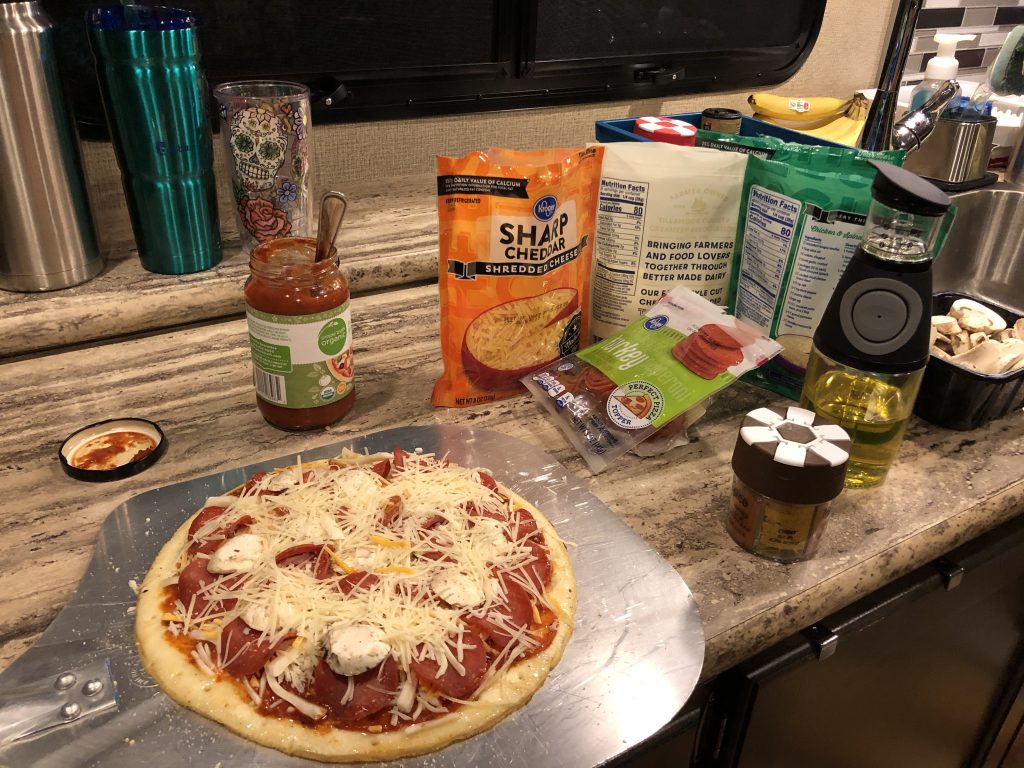
For dinner, I decided to make a pizza to cook on the grill. If you can spare the space, a great camping grill is the Big Green Egg Mini Max. While it’s heavier than most small grills out there, it cooks great. The way the food turns out makes it worth bringing if you are RV/camper or car camping, but isn’t realistic if you have to carry it any distance. Another great option (and a much lighter option at that) is a Weber 14″ Portable Grill. I used the Weber before I had the Big Green Egg.
You could make own pizza dough ahead of time to bring on the trip. Or if you don’t have time or care to do that, grab some pre-made dough, which you can find at Kroger, Publix, or Whole Foods. If you don’t feel like dealing with dough, an even easier and still tasty option is Caulipower 10in Pizza Crusts . No matter which crust you use, just add your own toppings and throw it on the grill!

Day 3: Resting & Refueling Day
For my last full day camping, I decided to rest and enjoy lots of good food. I slept in until around 9:45am. Then I made coffee and got the fire restarted first thing to try out a new brunch recipe – breakfast potato boats.
I slow cooked 2 baked potatoes in the coals of the campfire. Once the potatoes are finished, scoop out the insides, and mix the inside of the potato in a bowl with eggs, peppers, mushrooms, and cheese. Then scoop the mixture into the outer part of the potato, and cooked that on the grill for about 15+ minutes. They were quite tasty and I would definitely make them again in the future.

The rest of the morning and early evening, I read books, researched hikes I want to do in the future, went for a walk around Enota, and put a puzzle together outside on a card table.
For dinner I slow cooked chili in a dutch oven over the campfire. Chili is a super easy camping option. Pick what you want to include and throw it all in the pot with lots of spices and seasoning. It always turns out delicious!

After dinner was cleaned up, I watched a few episodes of Mindhunter that I had downloaded to an iPad from Netflix and had one last night of s’mores.
Day 4: Time to Head Home
Usually, I like to spend my last morning of camping enjoying one last breakfast and coffee before unhooking the RV. But, this time, I got up and packed up the RV fairly quickly because it looked like it was going to rain. Luckily, I was able to unhook, drop off the RV at the storage facility (National Indoor RV Center), drive home, AND unload the car, all before the rain started! It was a very enjoyable, relaxing trip. And for my next adventure, I can’t wait to get the opportunity to test out what I learned on an overnight hike!

Can’t get enough of North Georgia? Check out my other post: